
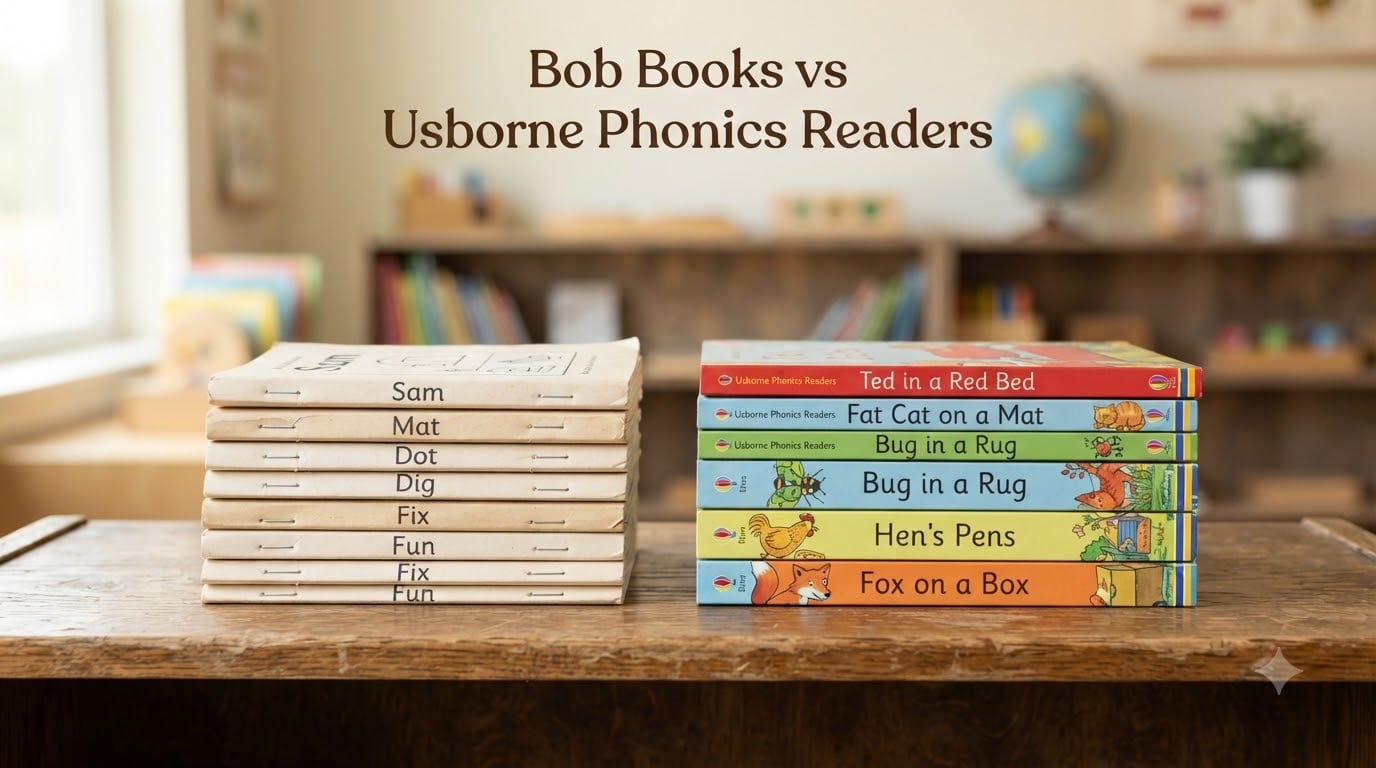
When my daughter was four, I stood in our homeschool shelf staring at two stacks of books, trying to decide between Bob Books vs Usborne Phonics Readers. Both promised to teach my child to read. Both came highly recommended by friends. But they could not feel more different once you crack them open.
Six years later, after putting thousands of pages in front of three different kids, I have a much clearer view of what each program does well and where each falls flat. This guide compares Bob Books and Usborne Phonics Readers side by side so you can pick the right starting point for your child without spending a fortune on the wrong set.
Table of Contents
Quick Verdict: Which Is Better?
Neither program is universally “better.” Bob Books win on price, progression, and strict decodability. Usborne Phonics Readers win on illustrations, story quality, and child engagement. If your child is a beginner who needs a no-frills phonics ladder, choose Bob Books. If your child needs engaging stories to stay motivated, choose Usborne.
Most of the homeschool parents I talk to end up using both at different stages. Bob Books for the very first lessons when the alphabet is still new. Usborne once the child can blend three-letter words and wants something more fun to read.
What Are Bob Books?
Bob Books are a set of small early reader books created by Bobby Lynn Maslen, a teacher, and illustrated by her husband John R. Maslen. They were first published in 1976 and have been a staple in American early reading instruction ever since.
The series is broken into four stages:
Stage 1: Beginning Readers – short books using mostly three-letter words (CVC patterns like “cat,” “dog,” “sun”).
Stage 2: Advancing Beginners – introduces consonant blends and longer words.
Stage 3: Word Families – builds fluency with rhyming families and compound words.
Stage 4: Complex Words – covers longer vowels, silent e, and tricky combinations.
Each book is about 12 to 16 pages. The illustrations are simple black-and-white line drawings. The print is large. The vocabulary is tightly controlled so that every word can be sounded out using phonics rules already taught.
There is also a Pre-Reading Skills set for kids who are not quite ready for stage one. It covers alphabet recognition, rhyming, and shapes.
What Are Usborne Phonics Readers?
Usborne is a UK-based children’s book publisher that has been around since 1973. They publish several phonics-based series, and the most popular for beginners is called Very First Reading, a set of 15 books designed to take a child from letter sounds to independent reading.
Other Usborne phonics series worth knowing about:
Very First Reading – 15 books plus a parent guide. Designed to be the first books a child reads aloud with a parent.
My First Reading Library – 50 books total, mixing phonics with classic tales like “The Tortoise and the Hare.”
Usborne Phonics Readers – stand-alone storybooks that focus on specific phonics sounds (like “sh,” “ch,” “th”).
Usborne books are full color with detailed, charming illustrations. The stories often have a sense of humor that older toddlers and young children enjoy. Print size is smaller than Bob Books, but the pages are larger and more durable.
Bob Books vs Usborne Phonics Readers: Side-by-Side Comparison
| Feature | Bob Books | Usborne Phonics Readers |
|---|---|---|
| Target age | 4-7 | 4-7 |
| Number of books per starter set | 12 (Stage 1) | 15 (Very First Reading) |
| Illustrations | Black and white line drawings | Full color, detailed |
| Page size | Small (about 5.5 x 4 inches) | Larger (about 8 x 5 inches) |
| Phonics approach | Strictly decodable, three-letter words first | Decodable, parent-led reading |
| Sight words | Introduced gradually as needed | Used naturally in story context |
| Comprehension questions | Not included | Discussion prompts in parent guide |
| Typical price for starter set | Around $16 for Stage 1 | Around $70-80 for Very First Reading |
| Library availability | Widely available | Available but less common in US libraries |
| Best for | Struggling or cautious readers | Engaged learners who love stories |
Phonics Approach: Are Both Truly Decodable?
This is where the Bob Books vs Usborne Phonics Readers comparison gets interesting for parents who care about strict phonics. Both programs call themselves decodable, but they take slightly different paths.
Bob Books are ruthlessly decodable in the early stages. Stage 1 introduces only a handful of letters at a time. Every word on the page can be sounded out using letters the child already knows. The few sight words that appear are introduced deliberately, one at a time, and reviewed in subsequent books.
Usborne’s Very First Reading series is also phonics-based, but it is designed as a shared reading experience. A parent reads the left-hand page, and the child reads the right-hand page. This means the parent reads sentences that may include words the child has not yet learned, while the child’s pages stick closer to decodable text.
For parents who want a strict phonics-first program with minimal sight words, Bob Books wins. For parents who want a warm reading-aloud tradition with phonics built in, Usborne is a strong choice.
Illustrations, Engagement, and Kid Appeal
Kids vote with their attention, and this is where the two programs split sharply. Usborne Phonics Readers look like real picture books. The illustrations are colorful, often funny, and full of small details that reward a second look.
Bob Books illustrations are functional. They are simple line drawings that match the text on each page. They are not bad. They just do not light up a reluctant reader the way a glossy Usborne page can.
One homeschool mom on Reddit summed it up well: “My first kid loved Bob Books. My second one thought they were boring and we switched to Usborne.” That pattern shows up over and over in parent forums. Some kids do not care about pictures and just want to crack the code. Other kids need a story they care about to stay engaged.
Price, Value, and Library Availability
Price is a real difference between these two programs. A Bob Books Stage 1 set typically runs around $16. You can get all five main stages for under $80 total, and many libraries carry them.
Usborne’s Very First Reading set costs around $70 to $80 for the 15-book collection. The bigger My First Reading Library runs higher, sometimes $100 or more. Usborne books are less common in American public libraries, though they are easy to order directly from the publisher or a Usborne consultant.
If budget matters, Bob Books gives you far more reading practice per dollar. If your child will not touch a book without color illustrations, the Usborne price is worth it for the engagement factor.
Which Should You Choose?
Pick Bob Books if your child is just starting out, learns well with repetition, or has shown signs of reading struggle. The slow, controlled progression gives new readers a lot of small wins, and the low price makes it easy to start.
Pick Usborne Phonics Readers if your child loves stories, enjoys being read to, and you have time to sit together for shared reading. The Very First Reading series is ideal for a 15-minute daily routine.
Honestly, both are worth owning. Many parents use Bob Books for the very first lessons and then graduate to Usborne once the child can read short sentences on their own. You do not have to pick just one.
FAQs
Do Bob Books use phonics?
Yes. Bob Books are built on a strict phonics approach. Every word in the early stages can be sounded out using letter sounds the child has already learned. Sight words are introduced gradually as needed.
What level of reading are Bob Books?
Bob Books cover four stages from absolute beginner to early chapter reader. Stage 1 is for kids just learning letters and three-letter words. Stage 4 covers long vowels, silent e, and more complex combinations. Most kids finish the series by end of first grade.
Are Usborne Phonics readers good for learning to read?
Yes. Usborne’s Very First Reading series and Phonics Readers are designed by literacy experts and follow a structured phonics progression. The shared reading format works well for parent-led instruction and builds early reading confidence.
Do Bob Books have sight words?
Yes, but only a few. Bob Books introduce sight words one at a time in the early stages and review them in later books. The series is more strictly decodable than most beginning readers, but it does include common high-frequency words like ‘the’ and ‘and.’
Can I use both Bob Books and Usborne together?
Absolutely. Many parents use Bob Books for the first lessons when the child is still learning letter sounds, then add Usborne Phonics Readers once the child can blend simple words. The two programs complement each other well.
Final Verdict
Comparing Bob Books vs Usborne Phonics Readers is less about finding a winner and more about matching the program to your child. Bob Books is the better choice for a strict, low-cost phonics ladder. Usborne Phonics Readers is the better choice for a child who needs colorful stories to stay engaged.
For most families, the best path is Bob Books first, Usborne second. Start with Stage 1 of Bob Books when your child is four or five. Once they can read simple sentences confidently, add the Usborne Very First Reading set to round out the experience. By the end of first grade, you will have a child who reads, and that is what matters most.